The Engineering
Underneath
This is the technical read. If you want the short version, the home page covers what you get and how to start. Here we go through which objectives get solved together, the pipeline this replaces, what the engines actually are, and the questions engineers put to us.
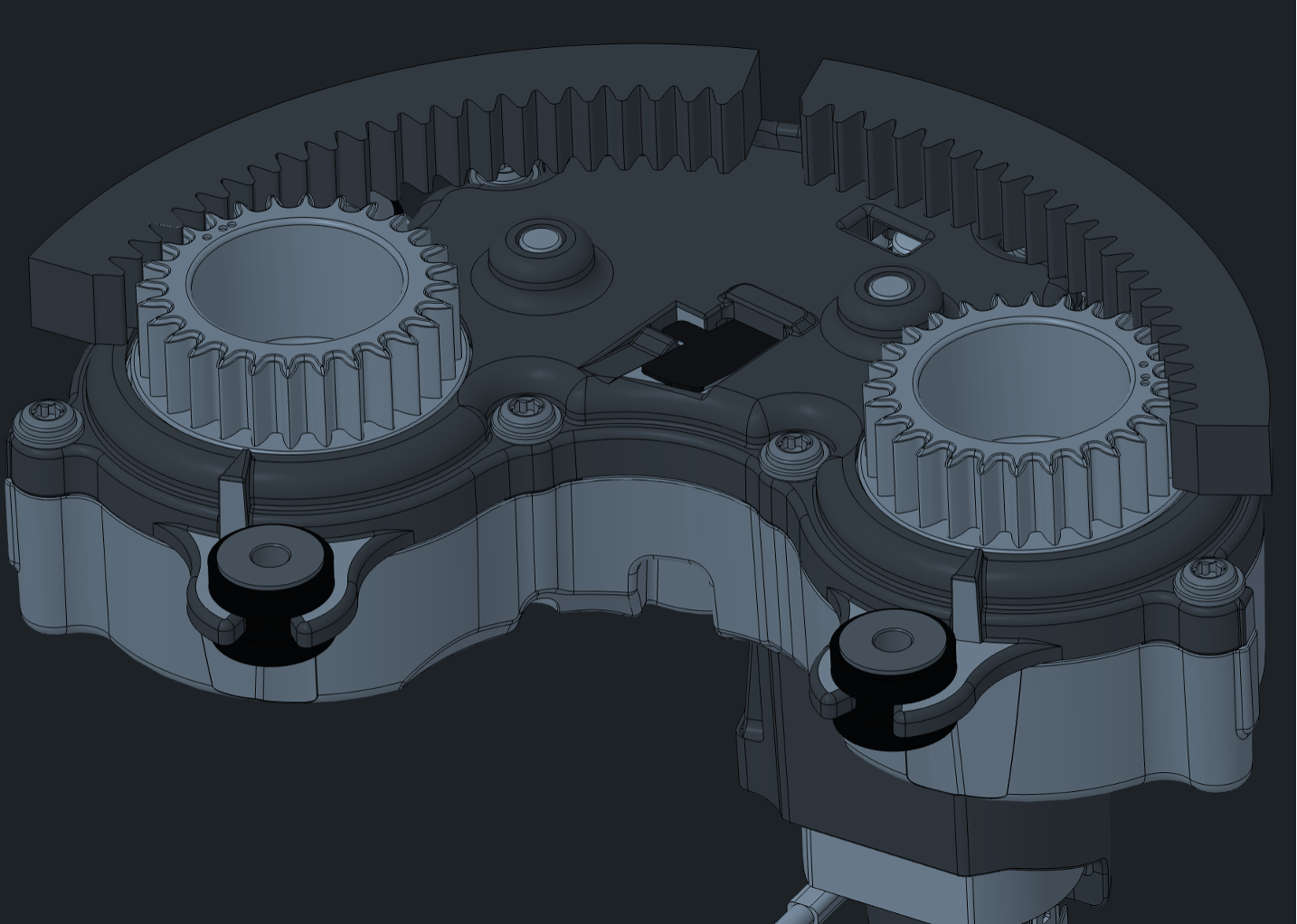
The Modules: One Engine, Three Kinds of Objective
These three are what sits inside the four jobs on the home page: the proven building blocks we assemble your CoDesigner from, not features you switch on. They get solved together rather than one at a time, because a part that is stiffer but unmoldable is not a better part. New disciplines get added continuously; if you can describe it, we can build software for it.
Make the Part Perform
Physics happens in the volume. Stiffness, strength, flow, thermal, vibration and contact pressure, computed through the whole body of the part against an objective you set.
And not one objective at a time. Because every surface, point and feature is under our control, we can optimize for stiffness in one region and for flow in another, then solve for the shared optimum instead of trading one against the other by hand.
stiffness · strength · flow · thermal · vibration · contact pressure
Make the Part Manufacturable
Manufacturability is decided on the surface. Draft, wall thickness, tolerances and machinability all live on the skin of the part, and that is where the expert-bound, process-specific work gets automated.
wall thickness · draft · fillets · undercuts · tolerances · machinability · gating · cooling · compensation
Make It Fit the Whole
Assembly is decided in the gaps. Most compliance sits at the interfaces, so we reason across the parts that meet rather than one part in isolation.
collision / clearance · tolerances · functional fits · assembly intent
// and more, added often
The Pipeline, Before and With CoDesigner
This is the only place we contrast with how you work today. The expert-bound middle is scattered across disciplines and tools, and DFM tends to arrive late; CoDesigner brings it into one controlled flow.
↺ simulate, read, correct, repeat, and DFM is only really confronted at the tool.
The engineer owns the intent. CoDesigner automates the middle. One module in your workflow, or the whole pipeline.
The Real Work Happens Under the Hood
When the physics is in the code, the software does the hard work of changing the geometry, so you focus on the intent and function of the part. The code does the rest, around physics optimization and DFM.


Core · the multiplier
Geometry Engine
Re-encodes CAD as differentiable geometry, every surface and point addressable and movable, which is what lets an algorithm change a real part instead of reporting on it. It is process-agnostic, so the same engine reaches past molding to CNC next.
Ours · from first principles
Flow Engine
A full 3D flow solver, written from the Navier–Stokes equations up by our own mathematicians, so we can run it thousands of times inside the optimization loop instead of once as a check at the end.
Open solver + our layer
Structural Engine
Modal, eigenfrequency and linear elasticity, run automatically across the design space, where every candidate evaluated is real, manufacturable geometry with wall thickness and rounding respected.
// built on CalculiX and PrePoMax, proven open-source FEM. Ours is the optimization loop and the geometry coupling.

The Questions Engineers Actually Ask Us
Usually in the first twenty minutes of the first call. The answers do not change on the second.
01How Do We Know the Results Are Correct?
Because it is deterministic and reproducible: the same input gives the same output, every run. You verify it against your own FEA and your own measurements, on your own parts, and we validate together before anything is trusted. We would rather be checked than believed.
02Is This Just AI Hype?
No. There is no LLM anywhere near your geometry, and nothing is trained on your data. It is deterministic physics and computed geometry: same input, same output.
AI changed the compiler, not the geometry. It collapsed the cost of writing software, which is why a piece of software built around one customer's parts is now worth building at all. The value stays where it always was: in the engineering knowledge and the depth of focus. AI is what lets us ship it as code.
03Where Does This Fit with the Tools We Already Have?
Alongside them. It runs next to your simulation stack and your CAD, and automates the manual loop in the middle: the part where an engineer changes geometry, re-checks it, and changes it again.
04How Do You Know You Have Not Just Found a Local Minimum?
We use optimization algorithms that explore the search space as globally as we can, usually a global search combined with local fine-tuning, exploiting whatever structure the specific problem has so it can be solved efficiently.
Being straight about the mathematics: for a non-convex problem nobody can guarantee the global optimum, and we will not claim otherwise. What we build are heuristics that find the right solutions in practice, and we are happy to go through exactly how we would approach your problem.
05What Does CoDesigner Decide, and What Do We Decide?
The hard question stops being what can be computed and becomes what should be. That is why every capability we ship names who holds the decision, and we move one up a mode only when your own data says it is ready.
Automatic. The engine generates the geometry and writes the output. Used where the physics is unambiguous and the result is verifiable: element ranges, wall-thickness fields, tool geometry. The rules decide.
Guided. We compute the change and show it on the part with the reasoning. Your engineer approves it and applies it. Used where judgment matters: parting-line placement, function-critical surfaces, anything on a regulated device.
Human only. We deliberately leave these with your people, and say so up front rather than letting you discover it in a pilot: final simulation sign-off, design intent and requirements, release of a validated device, the final tool assembly and sign-off.
We are strict about this because a tool that quietly makes design decisions cannot be validated under a design-control regime, and would not deserve your trust anyway. Refusing to automate sign-off is the point, not a gap.
06How Is This Different from CAD, Generative Design and Topology Optimization?
CAD captures intent quickly, but its values are constants rather than physics, so it does not produce a manufacturable result on its own. Generative and topology tools are strong at early concept shapes and lightweighting, and they will tell you where to put material, but the output is not manufacturing-ready and it stops at the part.
CoDesigner has control of every surface, point and feature, and returns manufacture-ready geometry for the part and the tool, deterministically. Finishing that last step is a different job from finding the shape, and it is usually the one that was blocking you.
07What About Keeping One Source of Truth in CAD?
Value first, integration after. It runs locally or in your own cloud, and you can apply the changes in CAD yourselves, so nothing is forced into your PDM before you have decided the result is worth having.
08Where Does It Run, and What Do We Own Afterwards?
It runs on your machines: on-premise, or in your own cloud. Your data and your parts stay yours, and the CoDesigner we build around your process is yours to keep.
We license the underlying engines and keep improving them, so what we learn on the solver side keeps reaching you.
09How Much of Our Time Does It Take, and What Do You Need From Us?
Limited time. We carry most of the work. What we cannot derive from the physics is the knowledge that lives in your team, and that is the part we need from you:
- A representative part, or a family of them, as you make it today.
- The step that takes the most expert time, and how often you repeat it.
- Your tooling standards, so the output fits the shop that will cut it.
- Where your tolerances actually matter, which no generic tool can infer.
- Validation at the checkpoints, from the engineer who owns the part.
Geometry can come to us under NDA before the first call if that is easier for you.
10How Long Until We See Results?
A proof of roughly three months delivers real geometry, with a checkpoint on the way, so you are never three months from knowing whether it is working. If it is not working, you find out at the checkpoint and we say so.